Certificate vs. country of origin
Abbreviation:
- CO
Definition:
- Usually marked in a “Made in” statement
- Exporter is responsible for this document
- Not required very often
- A document confirming in which country a good was manufactured
Purpose:
- Identifies where the product originated from
- Provides information about the goods to the country of import
- Sometimes needed for shipments to receive benefits of free trade agreements
- Confirms the status of the product
Example:
- “Made in China”
- If made in Italy, but shipped out of Germany, the CO will list Italy as the COO, not Germany
Steps to obtain a certificate of origin
Only exporters can issue a CO, and they must follow the steps below to acquire one for their shipment(s):
1. Determine products' COO
The COO is a section on the commercial invoice that is used when determining tariff rates. It also confirms the shipment’s legality and keeps track of the maximum quantity that can be imported into a country before incurring anti-dumping duty.
- How to determine the origin:
- Talk to the manufacturer to see if they can guarantee where the good is from. The marking on a good usually indicates where it is from as well.
- Wholly obtained or produced: A wholly obtained or produced good is produced entirely in one country with no foreign materials. If a good is made with imported materials or foreign labor, then a claim “Made in _____” (a single country) cannot be made. A good can only have the marking “Made in _____” (a single country) if it is made entirely of or nearly entirely of materials from a single country, with that same country’s labor.
- All goods of foreign origin must be marked indicating the product’s COO, and it must be legible and permanent.
- Substantial transformation: Substantial transformation is when a product goes through a considerable change compared to the item’s original form, resulting in a new use, name, and character. The Harmonized System (HS) code for a substantially transformed product is not the same as the original product’s code. If a good is substantially transformed, then the country where the good underwent the major change becomes the COO. Consider the following examples:
- Changing the color or print on a t-shirt does not change the COO.
- Assembling a screen, a computer chip, a battery, modems, sensors, and storage to create a smartphone does change the COO.
- Wholly obtained or produced: A wholly obtained or produced good is produced entirely in one country with no foreign materials. If a good is made with imported materials or foreign labor, then a claim “Made in _____” (a single country) cannot be made. A good can only have the marking “Made in _____” (a single country) if it is made entirely of or nearly entirely of materials from a single country, with that same country’s labor.
- Talk to the manufacturer to see if they can guarantee where the good is from. The marking on a good usually indicates where it is from as well.
2. Determine the certificate type
Definition:
- States that the goods do not qualify for preferential treatment
- Also referred to as “normal” or “ordinary” COs because this is the most common type of COs chambers can issue
Purpose:
- Used to apply for most-favored nation treatment (MFN) or for economic, political, or environmental reasons, including import quotas, boycotts, quantitative restrictions, countervailing or anti-dumping duties, etc.), such as regional, bilateral, and multilateral agreements
Purpose:
- Allow qualified products to be more competitive in foregin countries due to a 0% or highly discounted duty rate
- If shipped without a preferential CO, may receive standard tariff rate
- However, not all FTA shipments require COs; usually a simple declaration that contains data and information of how the product qualifies for an FTA is sufficient
- To determine what documentation is required, there must be communication between the retailer, consumer, and carrier
3. Contact local authority
The exporter’s chamber of commerce can help with the process of acquiring a CO. They can also let exporters know what is needed for certificate approval. Here is how it works:
- Provide the manufacturer's invoice or commercial invoice to show where the goods originate from.
- Fill out the CO document.
- Submit a notarized CO document and its corresponding invoices to the local chamber of commerce.
- Pay any applicable stamp fees for the documents that need to be stamped.
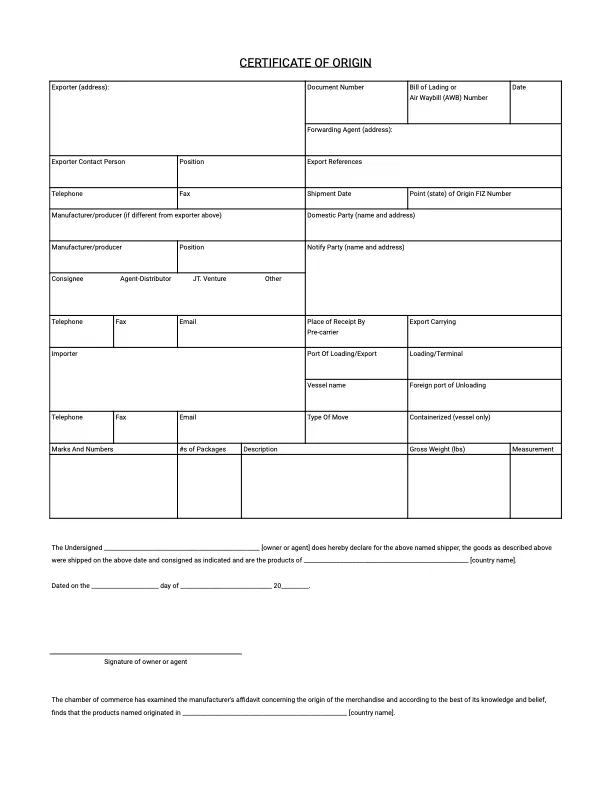
Certificate and country of origin
Learn about certificate and country of origin.A certificate of origin provides information about the goods in a shipment to the country of import, allows certain shipments to qualify for duty reductions or exemptions, and confirms the product’s validity. Determining a product’s country of origin and providing a certificate of origin to customs is required for particular goods.